Wedge bounce and
grind, explained
Bounce is the angle between a wedge's leading edge and its sole — it's what keeps the club from digging. Grind is how that sole is reshaped, usually around the heel and toe, to change how it moves through turf and sand. Here's what both actually mean, and how to choose your wedges without a professional fitting.
What is bounce?
Bounce is the angle formed between the leading edge of the wedge (the front-bottom edge that meets the ball) and the lowest point of the sole. Rest the club flat on the ground and that angle is bounce — it decides how much the sole "bounces" off the turf instead of digging into it.
More bounce presents more sole to the ground, so the club glides through soft turf, thick rough, and sand instead of catching. Less bounce lets the leading edge sit closer to the turf, which rewards a cleaner, more precise strike on firm ground and tight lies — but punishes a steep, digging swing.
Plays almost anywhere — the forgiving default.
4–6° · Low
Firm, dry turf and tight lies. Best for shallow-divot, cleaner ball-strikers.
8–10° · Mid
Most turf conditions, most golfers. The versatile, forgiving default.
12°+ · High
Soft, wet turf and heavy sand. Best for steeper attack angles and bigger divots.
What is grind?
If bounce is the angle, grind is the shape. Manufacturers remove sole material — usually at the heel, the toe, or both — to change how the club behaves beyond the raw bounce number.
Nothing removed — all the bounce works for you square, but open the face and the sole lifts the leading edge to the ball's equator.
Full / standard sole
Maximum bounce stays in contact with the turf. The most forgiving option, and a sensible default for most handicaps.
Mid grind (heel & toe relief)
Some sole shaved away for versatility — lets you open the face for flop shots without excess bounce fighting you.
Low-bounce / heavy relief (tour grind)
The least forgiving, most workable option — for players who strike the ball consistently and want to shape shots or vary attack angle.
Every manufacturer names its grinds differently (Vokey's letters, TaylorMade's numbers, and so on) — the concept above holds regardless of the badge on the club.
How to choose without a fitting
A real fitting will always sharpen this further — but you don't need one to land on a sensible wedge. Start from your handicap and your typical turf, then adjust from there.
| You | Start here |
|---|---|
| 15+ handicap | Higher bounce (10–14°), full sole |
| 5–15 handicap | Mid bounce (8–12°), mid grind |
| Scratch / tour-level | Lower bounce, more grind options — only with consistent contact |
| Play firm/dry courses | Lean lower bounce |
| Play soft/wet courses, heavy rough | Lean higher bounce |
| When in doubt | 10–12° bounce, standard grind |
Rule of thumb: forgiveness first. You can always move toward less bounce and more grind as your strike gets more consistent — it's a much easier trade than the other direction.
Ask Round Review AI about your wedges
Describe your miss, your turf, or what's in your bag — get a straight answer grounded in real, current wedge specs.
Tell me your handicap, the turf you usually play, or a wedge you're stuck between — I'll help you narrow it down.
Get the cheat sheet
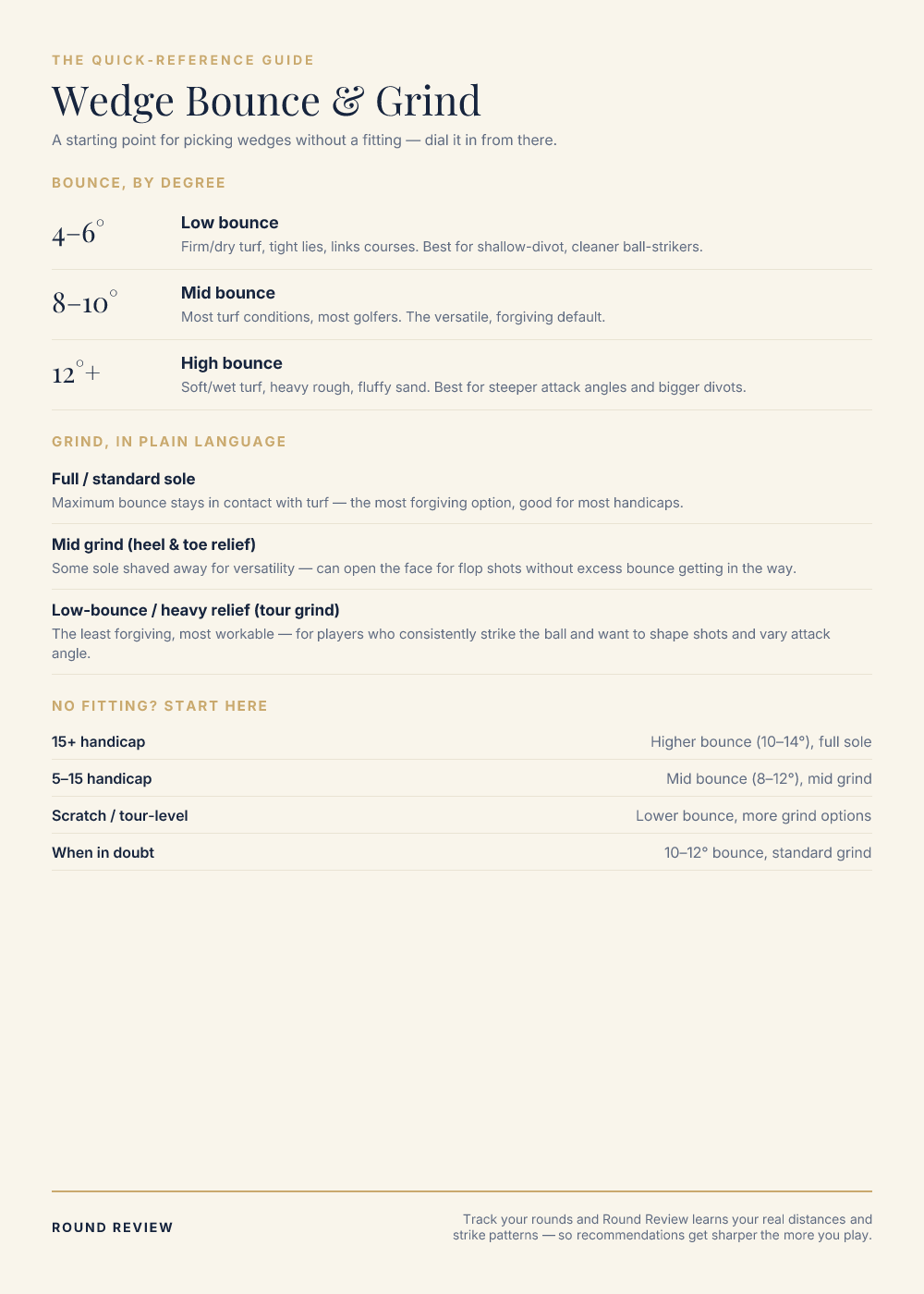
Same guide, one printable page — bounce ranges, grind types, and the no-fitting decision table, worth keeping in your bag.
Wedge Bounce & Grind Cheat Sheet
A quick-reference PNG — save it to your phone or print it.
Common questions
What is bounce on a golf wedge?
Bounce is the angle between the leading edge of the wedge and the lowest point of the sole. It's what keeps the club from digging into turf or sand — more bounce means more sole hits the ground first and resists digging; less bounce lets the leading edge get closer to the turf for cleaner contact on tight lies.
What is grind on a wedge?
Grind describes how the sole is shaped and relieved — usually around the heel and toe — to change how the club interacts with the turf beyond the raw bounce number. A full/standard grind keeps maximum sole in play and is the most forgiving; heavier grinds remove material for versatility, letting skilled players open the face or work the ball from different lies.
Should I get a high bounce or low bounce wedge?
High bounce (10 degrees or more) suits soft or wet turf, heavy rough, and players with a steeper attack angle or bigger divots. Low bounce (under 8 degrees) suits firm, dry turf and tight lies, and favors shallower, cleaner ball-strikers. Most golfers land in the middle — 8 to 10 degrees is the versatile, forgiving default.
Can I choose wedges without a fitting?
Yes, for a real starting point: pick bounce mainly by your typical turf conditions and how steep your attack angle is, and grind by your handicap — full sole and higher bounce if you're still building consistency, more relief and lower bounce as your strike gets more consistent. A fitting still sharpens it further, but it's not required to get a sensible wedge in your bag.
What wedges should a high handicapper carry?
Higher-bounce, full-sole wedges in the 10 to 14 degree range are the most forgiving starting point for higher handicaps — they resist digging on inconsistent strikes and work across more turf conditions. A gap wedge, sand wedge, and lob wedge spaced about 4 to 6 degrees apart covers most of the short game without needing a custom fitting first.
How this guide is built
This page teaches the concepts — what bounce and grind actually do to the club as it meets the turf. It isn't a scale model of any real wedge.
The figures are schematic, and deliberately so. Manufacturers publish bounce angles and name their grinds, but none of them publish the sole geometry itself — the relief depths and camber radii that separate one grind from the next are hand-ground and treated as proprietary. Even Acushnet's own patent filings describe the Vokey lineup in words rather than numbers: the M grind as "crescent-shaped with large relief surface," the K as having a "large camber radius from front-to-back." So when we show which parts of a sole a grind takes away — heel, toe, trailing edge, camber — we're following the manufacturers' own descriptions, drawn honestly but not to spec.
The bounce numbers deserve their own caveat. Most companies now quote "effective bounce" rather than a measured angle, and as Ping's VP of Engineering, Paul Wood, has written, there's no shared standard behind that figure — one brand's 8° isn't necessarily another's. Sole width matters just as much: Ping's thin-sole 60° measures 20° of actual bounce but plays like 6°, because the sole is only half an inch wide. Read the club lineups above as an ordering within each brand, not a ruler across them.
- Vokey Design — Wedge Grinds ExplainedTitleist's own descriptions of which zones each grind relieves.
- Paul Wood (Ping) — "What is effective bounce anyway?"Why bounce angle alone can't classify a sole, and why sole width is the more comparable number.
- US 12,064,674 B2 — Wedge golf club fitting system (Acushnet)The grind lineup described in a patent filing; bounce is the only geometry given as a number.
- MyGolfSpy Labs — The Wedge Sole TestOn-turf testing of three sole widths; strike quality predicted preference better than handicap did.