The golf tracker you talk to
Every shot tracked.
You just talk.Never tap a screen.
Say what happened. Round Review AI maps every shot, keeps score, and catches what you'd never tap into an app.
In private beta — we'll email you when there's a build to play.
“Solid drive down the left side of the fairway, just carried the bunker. Had 165 to the back pin — 8‑iron high cut to 12 feet below the hole. Sank the uphill putt for birdie, left to right a cup outside.”
Marked Driver · 274 yds — left side, fairway
Marked 8‑iron · 165 yds — high cut, 12 ft
Marked Putt — uphill, breaks L→R
“One seventy‑twoDistance · 172 yds, ball above my feetStance — stock sevenClub · 7‑iron, held a fadeShape · fade into the windWind · into. Flushed itStrike · flush, but it hung out rightMiss · right. Greenside bunkerLanded.”
You talk; Round Review AI does the bookkeeping — club, distance, lie, result, pulled from how you actually describe a shot. As much or as little tech as you want, on whatever you've got, whenever it suits you:
Apple Watch
A few words from your wrist, GPS-stamped. The phone never leaves the bag.
AirPods
Capture and caddie chat through whatever's already in your ears.
Phone
Talk between holes, tap a shot's exact spot on the map, or scan the scorecard after. As hands-on as you feel like being.
Car stereo
Talk the round through on the drive home — it's mapped by the time you're back.
Every shot
A sentence after the swing, hands free — or tap the exact spot on the map when you reach your ball. GPS stamps it, the AI logs it, you keep walking.
Between holes
Narrate the hole on the walk to the next tee. The AI sorts the story into shots — clubs, misses, the up-and-down.
After the round
Photograph the scorecard and talk it through on the way home. Zero on-course interaction at all.
Placed from your voice. Yours to the yard.
Behind the map is ShotPlacer — a spatial model built for how golfers talk. Every clue in a sentence, from the club to "carried the bunker," becomes a probability field over the hole's real geometry, and the shot lands where the clues agree: a maximum-a-posteriori estimate, not a guess.
In plain terms: we taught Round Review AI to place shots from what you say, what it knows about your game, and the course you're playing. And when you want a dot exact, drag it to the yard. It's your map.
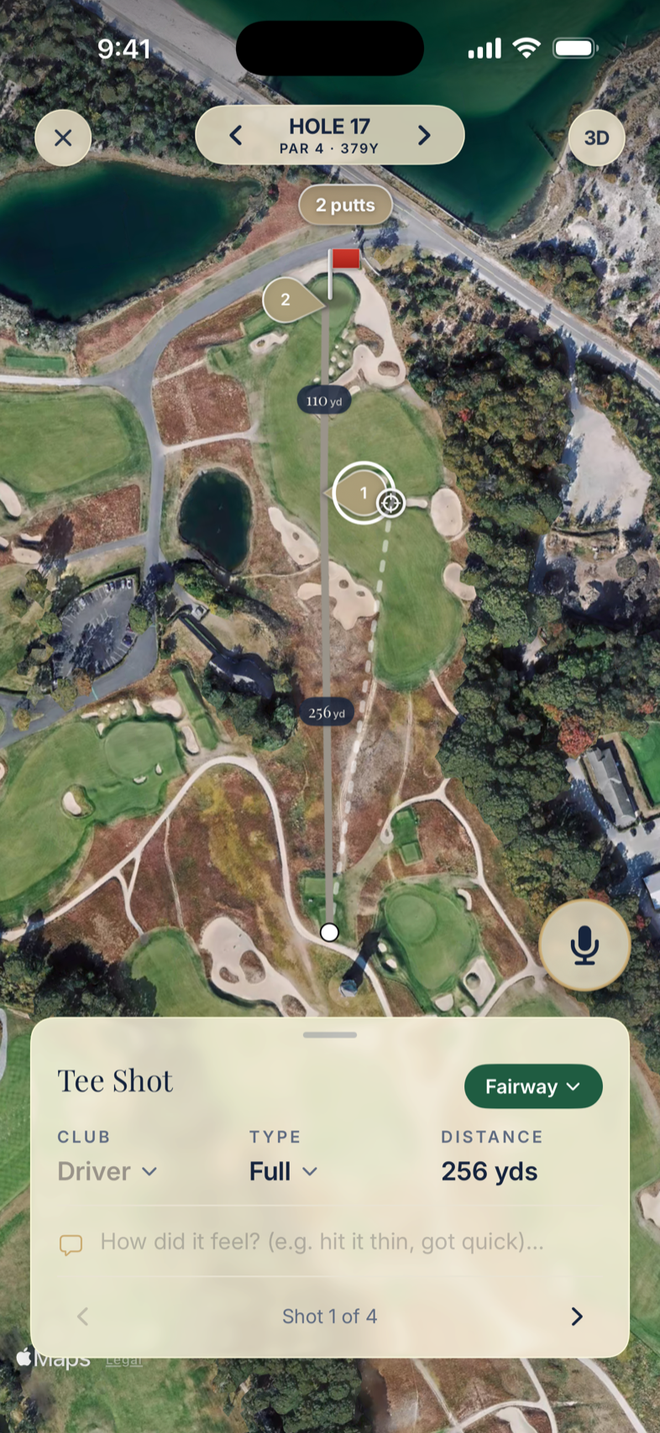
The numbers you'd expect. The filters you don't.
Club distances and dispersion are table stakes for a tracking app. Round Review runs a strokes-gained-against-your-level model to show you where you can actually improve, with best-in-class visualizations across off the tee, approach, short game, and putting.
Then the part no one else can track. Mention "a little lead tape on the driver" once, and your dispersion splits before-and-after. Say "first round with the jumbo grips" and see whether you're actually straighter off the tee. Loft tweaks, shaft demos, swing thoughts — if it matters enough to say out loud, it becomes an experiment you can read.
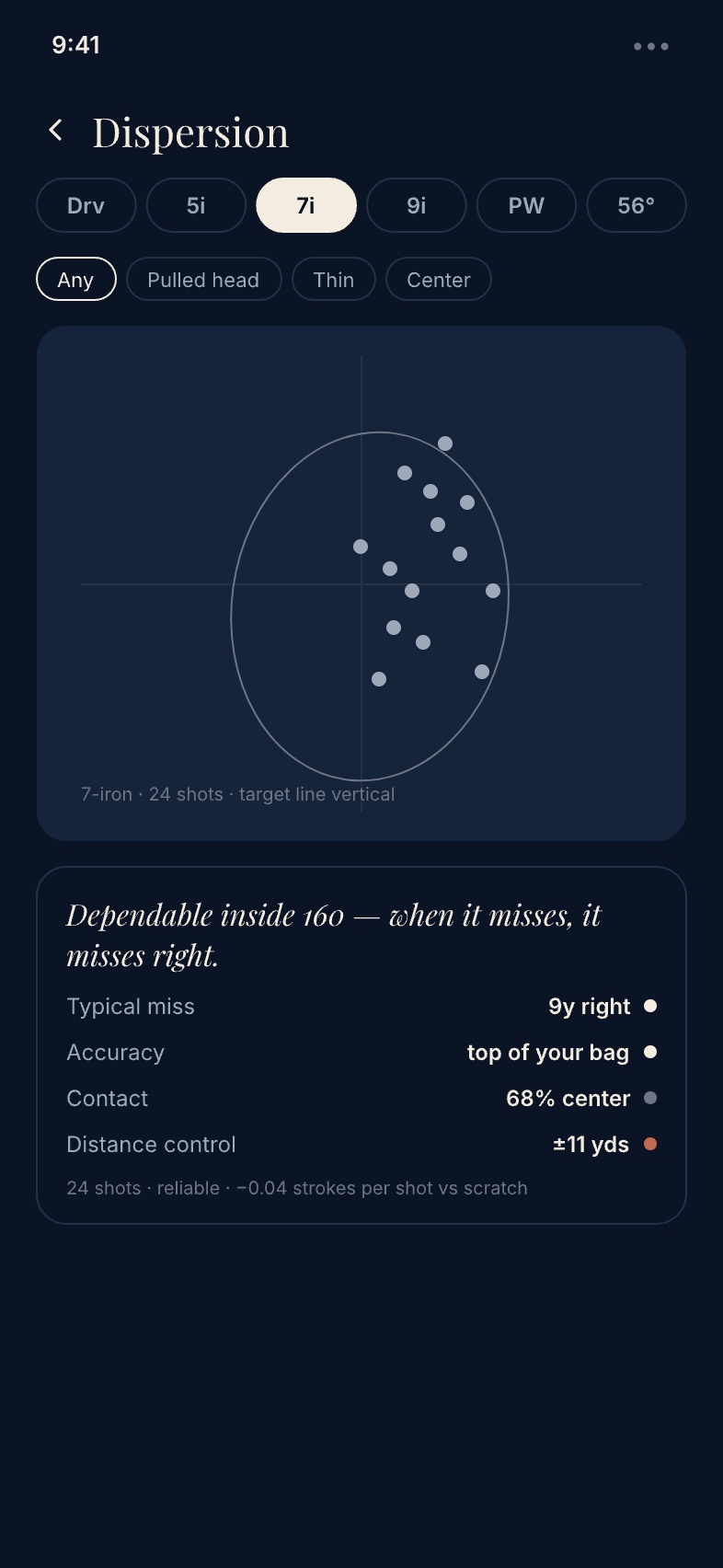
Every round, studied.
Every word, yours.
After each round, Round Review AI studies your whole game and writes up what it notices — the places strokes are quietly leaking that you'd never spot on a scorecard. Short, plain sentences about your golf, each backed by the shots behind it.
And it never corrects how you talk. "Pulled my head," "got quick" — your phrases are matched by meaning, never normalized to textbook terms, and connected to outcomes. So when you can say "when I pull my head, I miss short and right," a coach can go straight to club path and low point.
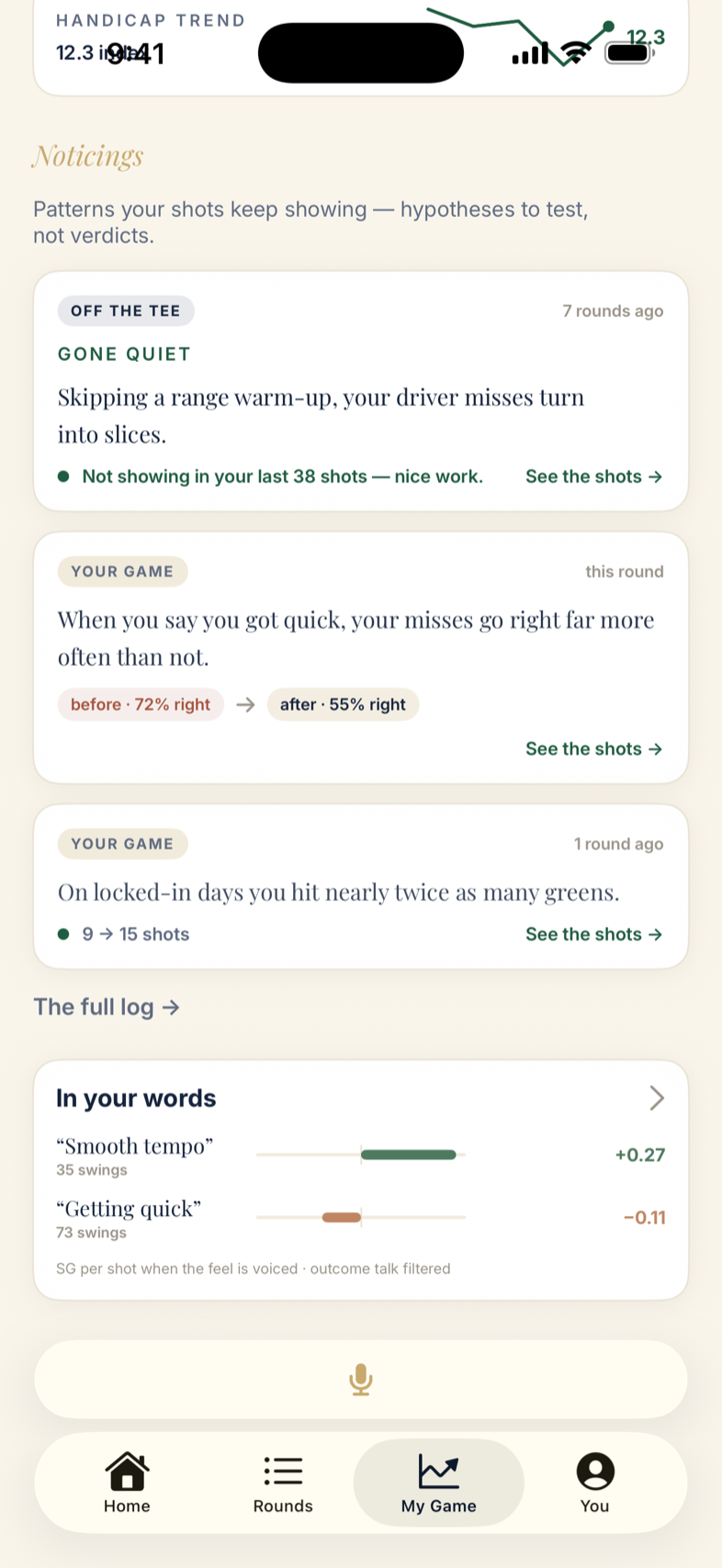
Grows with your game.
Newer to it? You finally get the basics — a shot map you trust, dispersion, strokes gained, and your own words handed back. Already dialed in? Say anything and query it later: the week you tried lead tape, the round your legs went at 14, the misses that only show up under pressure.
Same voice, same engine. The ceiling rises with the player — you decide what's worth tracking, and the data pays it back.
| GPS apps | Sensor systems | Round Review | |
|---|---|---|---|
| Hands-free capture | — | ✓ | ✓ |
| Nothing to buy or install on your clubs | ✓ | — | ✓ |
| Knows your target — and how it felt | — | — | ✓ |
| Track what you care about — gear tests, conditions, nerves | — | — | ✓ |
| Dispersion & strokes gained | — | ✓ | ✓ |
GPS apps log shots by tapping your phone all round. Sensor systems run $200–$600 in hardware before the subscription.
The data tax, repealed.
Sensor systems ask for $200 to $600 in hardware before the subscription even starts — a sensor screwed into every grip, a device clipped to your belt. Round Review runs on the phone already in your pocket and the watch already on your wrist.
The analytics a sensor system charges for — dispersion, strokes gained, a shot map you trust — come from what you already carry, and a few words.
Nothing to strap to your clubs. Nothing to charge but what you own.
It asks before it tells.
A seasoned looper, not a hype man — it states the round plainly, then hands you the narrative. Your answer gets written into the book while you talk.
Designed for a car at night. It treats your feel as data and never moralizes a number.
